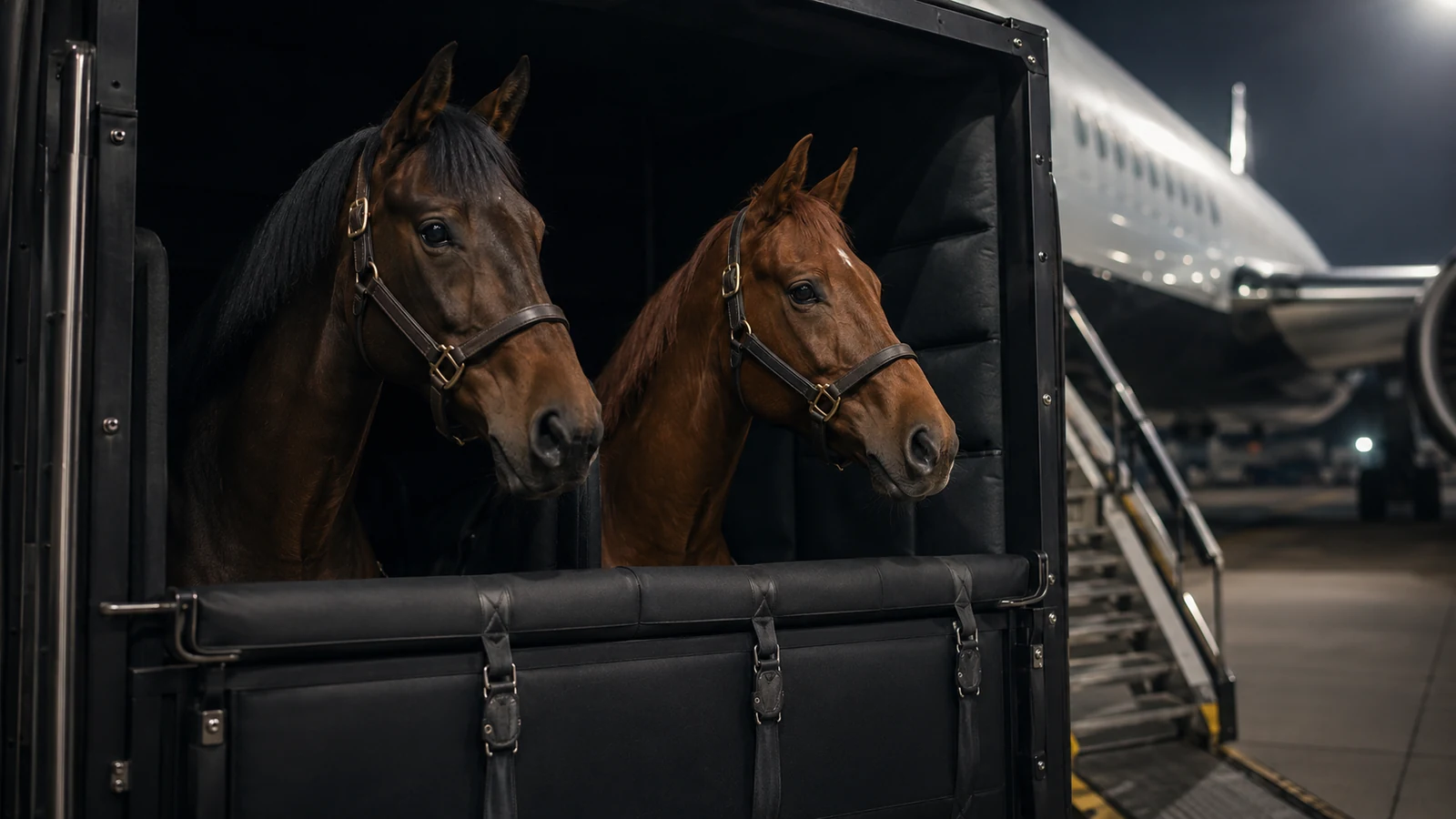
Aviation airstall, ready for international departure
International Export · Golden Horses Spain
Exporting a Horse from Spain: Piroplasmosis Testing and Export Documentation
Equine piroplasmosis is a blood-borne parasitic disease that shapes the export of Spanish and Portuguese horses to several international markets. It is not a disease that stops a horse from competing in Spain — it is simply the sanitary requirement that the United States, Mexico, Colombia, Chile, Argentina or El Salvador ask for before accepting an Iberian horse. This guide explains, with sourced and dated figures, what piroplasmosis is, how each destination country tests for it, and how an export is planned so the documentation is in order.
01 Piroplasmosis: What It Is and Why It Blocks Export
Equine piroplasmosis is a non-contagious blood parasite disease caused by two organisms: Theileria equi (formerly classified as Babesia equi) and Babesia caballi. Both destroy red blood cells from inside, causing anaemia of variable severity. They do not spread horse-to-horse through the air or by contact — they need a tick to carry them from one animal to another, principally hard ticks of the genera Dermacentor, Hyalomma and Rhipicephalus, all well established across the Iberian Peninsula.
That vector density is exactly why Spain carries a structural piroplasmosis problem for export. It is not a reflection of poor horse husbandry — it is geography and climate.
animalshealth.es, Feb 2020
T. equi & B. caballi — WOAH
USA, MX, CO, CL, AR, SV
Because the United States and most Latin American destinations are either free of the disease or maintain strict control zones, they treat seronegativity as a non-negotiable condition of entry — not a formality. Age matters too: exposure to ticks is cumulative, so the probability of a horse testing seropositive rises with every year it spends on Spanish pasture. This is one of the reasons export planning is dramatically easier when it starts early in a horse's life rather than after a sale is already agreed.
02 Clinical Signs and Laboratory Diagnosis
Incubation runs roughly 10–30 days for Babesia caballi and 12–19 days for Theileria equi. Most exported sport and breeding horses are chronic, asymptomatic carriers rather than visibly sick animals — which is precisely why serological testing, not a clinical exam alone, is what every destination country requires. A horse can look, move and compete perfectly and still be seropositive.
Clinical disease, when it does appear, ranges from a rare hyperacute form (sudden death within 24–72 hours, seen mostly with heavy T. equi loads) through acute and subacute presentations — fever, lethargy, anaemia, jaundice, swelling of the lower limbs — to a chronic form with vague signs like poor exercise tolerance and weight loss. None of that is what determines export eligibility, though: what matters is the laboratory result.
The Diagnostic Standard: cELISA
Direct microscopic identification of the parasite on a blood smear only works reliably during the acute phase, and asymptomatic carriers show no parasites on a smear at all. For international trade, every country in this guide requires an indirect serological test: Complement Fixation, Indirect Immunofluorescence (IFI) or, most commonly, the competitive Enzyme-Linked Immunosorbent Assay (cELISA) — the gold standard for detecting antibody carriers with the sensitivity international regulators demand.
Sample handling matters more than buyers usually assume: laboratories typically require around 5 ml of whole blood or 1 ml of serum, refrigerated at approximately 4°C and processed within roughly 24–36 hours of collection, since haemolysis from freezing, heat or rough handling can invalidate the result. A sloppy sample can cost a shipping window as surely as a positive result can.
03 Exporting to the United States: USDA/APHIS Requirements
The USDA declared the country free of piroplasmosis in 1988, but subsequent outbreaks of T. equi in Florida, California, Georgia, Colorado, Oklahoma and Texas mean the US now treats it as a disease under active federal control — regulated under 9 CFR 93.300–93.314, enforced by APHIS (the Animal and Plant Health Inspection Service).
Before the horse leaves Spain
- Import permit: requested through the APHIS eFile system, generally at least 7 business days before shipping, with a validity of around 14 days for live equines.
- Veterinary exam and export certificate: an official Spanish government veterinarian must examine the horse the same day the export certificate is issued, certifying no clinical signs of infectious disease. The certificate must be an original paper document, in English or accompanied by a certified translation, signed by an official inspector.
- No vaccination window before departure: live, attenuated or inactivated vaccines are not permitted in the days immediately before shipment — confirm the exact cut-off on the current ASE-2221/ASE-2222 attestation before scheduling, as this window is one of the details buyers most commonly get wrong.
- Pre-export isolation — not a fixed period, but a reality for most horses: the US does not require a mandatory pre-export isolation period by regulation, but in practice only foals and geldings under 24 months clear in a matter of days (bloodwork plus certificate). Horses over 24 months stay 3 to 4 weeks at the origin facility while the 3 Contagious Equine Metritis (CEM) tests are completed and results come back. Golden Horses works with Equus Export, a MAPA-approved equine concentration centre in Alicante.
ASE-2221 vs. ASE-2222: the certificate that decides your CEM quarantine
Because Spain is considered a Contagious Equine Metritis (CEM) affected country, which certificate applies changes everything about your post-arrival timeline:
| Certificate | Applies to | Post-arrival CEM quarantine |
|---|---|---|
| ASE-2221 | PRE stallions/mares over 731 days old, ANCCE-registered, that have never been used for breeding, with an addendum from the official vet of origin | Exempt from the extended CEM quarantine, provided ANCCE breeding records confirm no reproductive history |
| ASE-2222 | All other equids — geldings of any age, any breed under 731 days, non-PRE stallions/mares over 731 days, or PRE over 731 days previously used for breeding | Mandatory state CEM quarantine after release from the federal AIC: mares ≈15 days with bacteriological swabs; stallions up to 5 weeks, including a daily chlorhexidine (2%) genital wash for 5 consecutive days |
The 731-day threshold is exactly two years — and it is unforgiving. Any gap or inconsistency in the ANCCE breeding record invalidates the ASE-2221 exemption and pushes the horse into the ASE-2222 quarantine track, with the extra weeks and cost that implies.
On arrival: the Animal Import Center
Every horse from the Iberian Peninsula lands at an authorised US port (Miami, New York, Los Angeles and others), is inspected by a USDA veterinarian, and is transferred to an approved Animal Import Center (AIC) for a mandatory federal quarantine of at least 3 days (72 hours). Blood is drawn there and sent under chain-of-custody to the National Veterinary Services Laboratories (NVSL) in Ames, Iowa, for four tests that must all return negative before release:
- Equine piroplasmosis — cELISA for T. equi and B. caballi
- Equine Infectious Anaemia — Coggins test (AGID)
- Glanders (Burkholderia mallei) — Complement Fixation
- Dourine (Trypanosoma equiperdum) — Complement Fixation
Results are usually available on the third day. A positive or reactive result on any one of these four tests means automatic rejection: repatriation or, in the worst case, euthanasia under official supervision — with every cost falling on the exporter or importer, not the government.
04 Exporting to Latin America, Country by Country
Each destination negotiates its own bilateral protocol with Spain's Ministry of Agriculture (MAPA), formalised as an official ASE attestation via CEXGAN. The core piroplasmosis logic repeats everywhere — pre-export isolation, a negative serological test within a set sampling window, a short-validity certificate — but the details diverge enough to catch out anyone assuming one country's rules apply to the next.
Mexico — SENASICA (ASE-2528)
Reopened after a prolonged closure dating to 2015, Mexico's protocol requires official quarantine at the farm of origin for 28 days before departure, with no live or attenuated vaccine in the 30 days prior. Piroplasmosis is tested by Complement Fixation, IFI or cELISA during that quarantine window.
Mexico's genuinely distinctive requirement is genomic identification: 100% of exported horses undergo DNA profiling at the Laboratorio Central de Veterinaria in Algete (Madrid) across a panel of 20 microsatellite markers (AHT4, AHT5, ASB17, ASB2, ASB23, CA425, HMS1, HMS2, HMS3, HMS6, HMS7, HTG10, HTG4, HTG6, HTG7, LEX27, LEX3, LEX33, VHL20 and AME), cross-checked against the breed's official studbook. Other mandatory tests include Coggins/ELISA for Equine Infectious Anaemia (valid within 6 months), three CEM bacteriological cultures roughly a week apart (geldings and horses under two years are exempt), Arteritis Viral Equina serology, and — since recent EHV-1 outbreaks — a mandatory negative PCR for equine rhinopneumonitis taken during the quarantine period.
Colombia — ICA (ASE-1031)
To protect the genetic and sanitary purity of national bloodlines such as the Colombian Paso Fino, the ICA requires at least 30 days of pre-export isolation, with piroplasmosis testing (IFI or cELISA) and tick-freedom both confirmed within the 30 days before shipment. After an EHV-1 outbreak traced to an equestrian venue in Valencia, Spain, Colombia significantly tightened biosecurity around any horse that had recently attended European equestrian events — buyers coming from active competition circuits should expect extra scrutiny and confirm current restrictions with Golden Horses before assuming a straightforward timeline.
Chile — SAG (ASE-2749)
Chile runs one of the most granular protocols in this guide: a minimum 21-day isolation period, with no piroplasmosis clinical signs on the property for 90 days and a negative ELISA or IFI within 30 days of shipment. The same 30-day sampling window applies to glanders, leptospirosis and West Nile virus, and to salmonellosis testing for entire males over two years and females over eighteen months (geldings are exempt). Attenuated vaccines are banned in the 90 days before travel; inactivated influenza and rhinopneumonitis vaccines are required within defined windows before departure, and a broad-spectrum antiparasitic treatment is mandatory in the final 7 days.
Argentina — SENASA
Argentina's Pampas region — the heart of its equestrian industry — has one of the lowest piroplasmosis prevalence rates in the region, historically around 5% in the 1980s and estimated at roughly 0.3–0.5% for T. equi today, according to figures published by the Federación Ecuestre Argentina. That low baseline is exactly why SENASA treats any reactor horse as high risk, barring seropositive animals from entering zones under active control. Following European EHV-1 outbreaks, Argentina also requires a negative PCR taken during origin quarantine, plus mandatory post-arrival isolation of at least 15 days with daily clinical monitoring and rectal temperature logging.
El Salvador — pre-export isolation and a longer certificate window (ASE-3645)
El Salvador requires at least 60 days of continuous residency in the country of origin and at least 30 days of pre-export isolation, with diagnostic tests — including piroplasmosis by Complement Fixation, ELISA or IFI — taken within 30 days of shipment. Influenza vaccination (for horses over six months) is required within 60 days of travel, and antiparasitic treatment within 15 days. The export certificate itself is valid for 30 days from issue, extendable to 45 with prior authorisation if the horse remains healthy and isolated — noticeably more forgiving than the US or Chilean timelines.
05 The WOAH Exemption: A Path for Seropositive Competition Horses
Not every seropositive horse is permanently excluded from international competition. Article 12.7.3 of the WOAH (World Organisation for Animal Health) Terrestrial Animal Health Code allows importing countries to authorise the temporary entry of reactor competition horses, provided strict vector-control biosecurity is in place — this is the mechanism that lets top-level sport horses compete abroad despite testing positive at home.
To qualify, the horse must travel with an official passport meeting the WOAH/FEI international format, and the exporting country's veterinary certificate must confirm no clinical signs of piroplasmosis on the day of shipment, plus an effective tick and acaricide treatment within the 7 days before departure. On arrival, the horse is confined within a tick-controlled perimeter, inspected periodically by the importing country's official veterinarians, and permitted to compete or train only under that isolation regime — kept apart from the host country's domestic herd for the duration of its stay.
06 Comparative Snapshot: Quarantine, Certificates and Testing
The grid below summarises, country by country, the ASE certificate, the pre-export isolation period in Spain and the diagnostic technique required for piroplasmosis. Days and validity periods on official ASE attestations are revised periodically — treat this as a planning reference, not a substitute for checking the certificate current on your shipping date.
07 Strategic Guidelines for a Clean Export
Golden Horses works exclusively for the buyer, which means our incentive on every export is the same as yours: no surprises at the border. These are the disciplines that keep piroplasmosis from derailing a purchase.
- Pre-testing before anything else. Before any official documentation, permit request or physical isolation begins, run a private cELISA and IFI at a reference laboratory. Identifying a seropositive horse early avoids paying for transport, permits and customs fees on an animal that will be rejected at destination — this is the single highest-leverage step in the entire process, and it should happen before you commit to a horse, not after.
- Favour younger horses for export-driven purchases. Because seroconversion risk accumulates with age and tick exposure, a young, carefully managed horse is statistically more likely to test clean than an older one from the same yard.
- Verify ANCCE breeding records early for PRE stallions. If ASE-2221 is the plan, any discrepancy in the reproductive history on file invalidates the CEM exemption — confirm this months, not days, before shipping.
- Treat biosecurity as non-negotiable during isolation. Environmental tick control in stables and paddocks, plus strictly single-use veterinary and grooming equipment, closes off the accidental (iatrogenic) transmission route between horses awaiting export.
- Build the calendar backwards from the certificate's validity window. Because several destination certificates are valid for only a handful of days from signature, laboratory results, CEXGAN sign-off and the physical inspection must be scheduled to land precisely before the sealed transport and international flight — not the other way around.
Note: sanitary and customs regulations change over time. The figures in this article are verified and dated against the official sources cited, but before scheduling any shipment, always confirm current requirements with Golden Horses or the applicable official ASE attestation.
We coordinate your export, start to finish.
Piroplasmosis testing, ASE certificates and quarantine timelines are exactly the kind of detail that makes or breaks an international purchase. We coordinate pre-purchase testing, documentation and export end to end, working only for you.
Sources and References
- WOAH — World Organisation for Animal Health. Equine Piroplasmosis and Terrestrial Animal Health Code, Chapter 12.7 (Article 12.7.3). woah.org
- USDA APHIS. Importing Live Equines and Equine Germplasm into the United States. aphis.usda.gov/live-animal-import/equine
- USDA APHIS. Import Horses from Spain (European Union). aphis.usda.gov/live-animal-import/import-horses-spain
- MAPA / CEXGAN. Nota informativa — Exportación de équidos a EEUU. servicio.mapa.gob.es/cexgan
- MAPA / CEXGAN. Atestación ASE-2221 (EEUU, PRE vírgenes) y ASE-2222 (EEUU, general). servicio.mapama.gob.es/cexgan
- MAPA / CEXGAN. Atestación ASE-2528 (México / SENASICA). servicio.mapama.gob.es/cexgan
- MAPA / CEXGAN. Atestación ASE-1031 (Colombia / ICA). servicio.mapama.gob.es/cexgan
- MAPA / CEXGAN. Atestación ASE-2749 (Chile / SAG). servicio.mapama.gob.es/cexgan
- MAPA / CEXGAN. Atestación ASE-3645 (El Salvador). servicio.mapama.gob.es/cexgan
- Federación Ecuestre Argentina. Resolución sobre Piroplasmosis. fedecuarg.com.ar
- Equus Export. Cuarentena de caballos para exportación: la antesala obligatoria de tu envío. equus-export.com
- EquiJet. Travel Process — CEM Quarantine Protocol. equijet.com
- Animal's Health. El 24% de los caballos de España no podría exportarse por piroplasmosis (6 Feb 2020). animalshealth.es